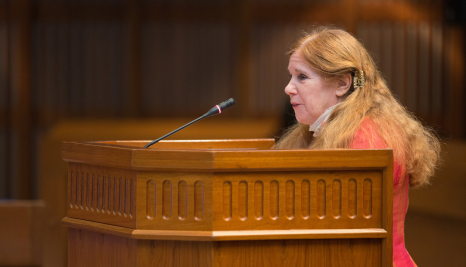
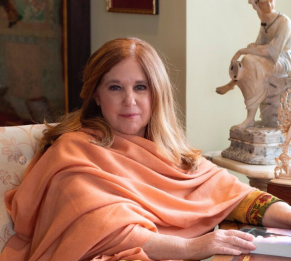
Close encounter Dana Merriam
October 2024
CLOSE ENCOUNTER
Ashish Virmani interviews Dena Merriam, who has had the most amazing experiences of past-life recall, thanks to her spiritual practice. She is a prolific author, a global promoter of women’s rights, and a devoted disciple of Indian and Eastern spirituality
Lifetimes of bonding with India
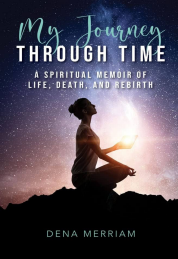
Years ago, I came across Dena Merriam’s book My Journey Through Time: A Spiritual Memoir of Life, Death, and Rebirth. I was subsequently mesmerised by the real-life story of Dena, an American-Jewish woman, who became a disciple of Paramahansa Yogananda at the age of 20. Born to an affluent family in New York in the early 1950s, she had to hide her Indian spiritual practices from her mother and relatives.
After Dena had been meditating for around 20 years, the door to her past lives, which had been slightly ajar in this lifetime, opened for her. She was able to see her past lives in the USA, India, Japan, Africa, and Persia with remarkable clarity while in meditation, to the extent that they played out in front of her as if on a movie screen. She recalled detailed conversations and specifics of her environments as well as the relationships that had populated her previous lives. The result was the book mentioned above, which is an enthralling read for those who believe in the concept of reincarnation.
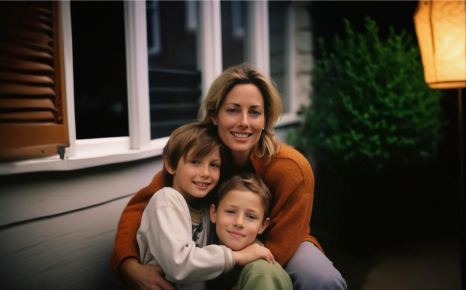
A mother to two young teenagers, during the late 1990s, Dena was drawn to spiritual inter faith activities. In the year 2000, she organised the Millennium Summit for spiritual leaders of the interfaith community worldwide under the guidance of the then-UN secretary gener al, Kofi Annan. She subsequently organised a global summit for women spiritual teachers in Geneva and then a summit for women in con flict zones. Setting up her organisation Global Peace Initiative of Women (GPIW) in 2002, she travelled to far-off locations like Africa, Japan, Iran, and India to organise spiritual and peace summits in the coming decade and a half, seeing spirituality as a primary resource for dealing with global challenges including environmental sustainability and climate change.
Besides having authored five books dealing with her past lives—of which To Dance with Dakinis is her latest—Dena is a prolific writ er with nearly a dozen other books on art and sculpture to her credit. She lives on the out skirts of New York in a country house where her children grew up and practises Kriya Yoga, which is advanced worldwide by the Self Realisation Fellowship (SRF) organisation.
This interview is compiled from a talk with Dena over a Zoom call as well as from answers she sent through email.
You began practising Kriya Yoga and meditat ing more than 50 years ago. What have been the greatest benefits of this five-decade jour ney into spirituality?
The greatest benefits have been an inner trans formation and a transformation in my world view: the way I understand and approach life. I will first address the inner transformation.
It took me some years to realise that the way to understand one’s spiritual progress is not by measuring or comparing one’s experienc es in meditation but, rather, by observing how one reacts to people and events in the outer world. In other words, do events and people still trigger emotional responses and disturb one’s inner calm? When I was much younger, I read something my guruji said: “One must stand unshaken amidst the crash of breaking worlds.” This statement has become a refrain over the years and has been a guide for me. To be unshaken, no matter what comes—that is the goal—and beyond that, to always remain in a state of inner joy. That is a bit more diffi cult, but it too is the goal. The second teaching that has had a great impact on me is to do no harm and cause as little suffering as possible through one’s deeds, words, and thoughts. Not to make any ripples because it is those ripples that stir the chain of action and reaction. The
third teaching has been to be an observer— most importantly, an observer of one’s mind and heart—and to be watchful and stay above the fray of the world.
My understanding of life has completely changed, and I no longer think of myself as only the body I now inhabit or the personali ty I now manifest. I have a long memory and know something of my history. I also know that between births, I abide someplace else, and that place is as real to me as the place I now inhabit. I see behind and ahead, and know that it is all one unending life with in
numerable chapters. I have also come to gain some understanding of the law of cause and effect, and know that is not a system of reward and punishment but rather a spiritual law that guides and aids the awakening process, to help us learn. We ourselves are the ones who determine our future. As my sense of identity has changed, so has my worldview.
Has the process of uncovering your past lives been completely pleasant or were there diffi cult moments also?
As I recalled my previous births, there were many difficult moments because, in a sense, I relived those lives. When I first began having these vivid experiences and found myself re
living many scenes from a birth just previous to my current one, it was very destabilising. I was a divorced mother of two teenaged sons, working a job, doing my spiritual practice, and experiencing difficult moments from my previous birth, seeing scenes and hearing con
versations that pained me. But on the other hand, I saw that I had met my guru in my pre vious birth, and that was a great joy.
At first, , I doubted myself and investigated many of the things I was seeing to confirm their accuracy. But subsequently, I no longer felt the need to do this as memories of earlier births returned to me. Each time I recalled a
Close Encounter 19
When I read the ancient
stories, there is no doubt in
my mind that I was there.
This is revealed in my
books The Untold Story of
Sita, When the Bright Moon
Rises, Rukmini and the Turn
ing of Time, and To Dance
with Dakinis. But in those
lives, I was a different me,
and my understanding was
far less developed.
life, I relived it, especially since I was writing about it. So I had to fully immerse myself in that period and personality. Eventually, I came to question who I truly was. I have been this one and that one, rich and poor, of different religions and ethnicities, so who am I truly? I recognise a part of each personality in who I am today. I am a compilation of all those past personalities, yet I am no longer them, and soon I will no longer be this personality. I will outgrow it. I look back at earlier versions of myself and see my growth and evolution over time. It is spectacular to behold!
In the book, you mention having previous births in India, the USA, Africa, Persia (Iran), Japan, and other places, which you have out lined in detail. What brought about the spe cial bond with India, seeing that many of your
20 LifePositive | OCTOBER 2024
subsequent books are centred around previ ous births in this country?
I have a deep and ancient connection with the land we now call India. It is where many of my early births took place, and those are my earliest memories. In addition, the teachings of the ancient rishis are deeply embedded in my mind and shape my worldview. When I read the ancient stories, there is no doubt in my mind that I was there. This is revealed in my books The Untold Story of Sita, When the Bright Moon Rises, Rukmini and the Turning of Time, and To Dance with Dakinis. But in those lives, I was a different me, and my understand ing was far less developed. I didn’t understand the teachings that I received then, but I have a much better understanding of them now as they are very relevant to the world today. That is why I am compelled to write so much about ancient India. The understanding of the knowledge transmitted at that time is fructi fying now. But I am also writing about the fu
ture. The book I am now working on is called Memories of a Future Life. Just as we can see the past, we can see the blueprint of the future (in our thoughts, words, and actions that are being planted now).
What do you feel you have contributed global ly through your organisation GPIW? I was asked to help organise a large spiritual summit at the UN for the millennial year 2000. Kofi Annan was the secretary general then. The UN just wanted top people from all religious traditions, who happened to be mostly men. People in the secretary general’s office kept telling me, “Make sure there are women.” But the big issue then was the fact that we couldn’t have the Dalai Lama because of China, so the gender issue got sidelined.
A few prominent women were attending the summit, such as Indu Jain and Jane Goodall, who weren’t spiritual leaders. We arranged
breakfast for them, and they asked me to or ganise a follow-up summit of women spiritual teachers. We went back to Kofi Annan with this, and he gave his assent. He wanted us to hold it in Geneva, which was much more dif ficult for us to organise. There was a lot of re sistance to this summit from the Geneva com munity, the interfaith community, and the top religious leaders, but we managed to organise it.
After Geneva, I thought my work was done; I’d done these two UN summits. But the wom en from the conflict areas (Israel and Pales tine) asked us to help them, and so we went there. Subsequently, we travelled to Africa, Japan, and India (among other countries) to help organise spiritual and peace summits in the next decade and a half.
At that time, the start of the millennium, the spiritual interfaith world was mostly male and Abrahamic (Christian, Jewish, and Islamic). There was not much participation from the
Hindu or Buddhist communities. So I said to myself, here’s where I can contribute. I can help reshape this. I can bring in the voices of women and the dharma (Hindu, Buddhist, and Jain) traditions. So that is what has been my contribution.
A lot of people are saying that in the 21st century, we are in the process of a shift in consciousness and that people are becoming more spiritually aware. What do you think?
Yes, absolutely. I’ve been around a long time, and I can see it over the course of my life. I was much younger when I started meditating and became a vegetarian in the USA. At that time, it was looked upon as being very weird. I had to hide a lot of it. I couldn’t talk openly about my meditation practice. All that has changed now—completely changed. There’s the phenomenon called the 100th monkey ef fect. When a certain percentage of the species gains a skill, it spreads through the species. We haven’t reached that number in terms of human spiritual awareness yet. But I think we will, in this century. I see that it’s about the growth of spiritual understanding and the deepening of spiritual practice. And it can happen overnight.
You come from an American background, which could possibly be viewed as a paradigm of scientific materialism. How has connect ing with a civilization like India helped you lead a more profound life?
As you know from reading my books, I have an ancient and deep connection with India. I came in contact with my guru’s teachings when I was 20, through reading his book Auto
biography of a Yogi. It was just something that I knew to be true; it wasn’t something that I had to be convinced of. It just made sense to me. A lot of my thinking was framed by the Indic knowledge system. But I didn’t recognise it until I read Yogananda’s book. For example, to me, the Divine Mother was always a reality. Now, that’s something that’s been considered very alien within the Western context. Because here it’s the Father and the Son. To me, it was always the Mother. So when I read Yoganan da’s autobiography, I saw where it came from! Also, being vegetarian was natural to me. My mother would force me to eat meat as a child, but I would spit it out into my napkin. A lot of the things that we associate with the Eastern worldview happened very naturally to me.
You talk a lot about the Sacred Feminine in your books. What do you see as the aspects of the Sacred Feminine (or Divine Feminine)? I have this image of both Ram and Sita, of Narayan and Narayani. Of course, there’s only one cosmic energy, but as soon as you have manifestation, you have division: the cosmic force known as Narayan, which is a creative, preservative force maintaining the universe, and Narayani, who performs the same func tion in a slightly different way. You see it actu ally in the narrative of Ram and Sita, which I
22 LifePositive | OCTOBER 2024
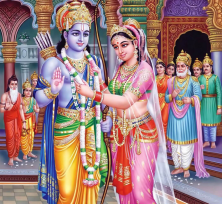
retell according to my understanding. Where Ram does the outer work, the more visible work, Sita, in Lanka, is working on the inner plane, the mental plane, with Raavan. So, I think a lot of the feminine work is the inner work. We all have both aspects within us. We have the need to display our outer power, and we have the need to cultivate our inner power. We have the need for strength, and we have the need for compassion. The key is to balance strength with compassion. In my own life, I’ve had more of the feminine energy, and I’ve had to cultivate a lot of that outer energy, the out er power, which has been difficult for me. I’ve drawn upon Ram as a guide for that.
Also, I’ve realised by looking at some of the Di vine Feminine figures, and even through my work with some women leaders, that there’s a very deep, intuitive connection with the Earth and the natural world. It could be cultivated by anybody, but it seems to come more natu rally to women because of our role in giving birth and holding life within us. Women emo tionally respond to what’s happening with the rivers or the degradation of the Earth. On the other hand, they can get overly emotional and not come from a place of wisdom. I’ve seen that it’s the pitfall that some women fall into.
Everybody does not have the ability that you have—to be able to see your past and future lives. What do you think your role in this life time is?
I think it’s not important to remember the spe cifics. What’s most important is to know that there was a past. And that it has shaped who you are now and all the conditions in your life. For example, you can work out a lot of things through self-reflection. You can tell if there are difficult relationships that have carried over from the past. You can either choose to resolve them now or in the future. The truth is that we do create our future in the present. So, if you can’t see the past, think about who you want to become. Because you are the Creator. Nobody is doing it for you. We don’t realise the extent to which we create our whole jour
ney. Who we were before has created who we are now, and who we are now is creating who we will be in the future (through our thoughts, words, and deeds in the present). We can do it consciously or unconsciously. Most of us, most of the time, do it unconsciously because we’re
not living mindfully. But I say it doesn’t mat ter. Take more control from this moment on and begin to shape who you want to become.
Also, there are several things that I think will help the human community advance. One is to develop a new attitude towards death—not to see it as an end but to see it as a completion of one thing and the beginning of another. Be
cause our lives are eternal, we take on differ ent personae and bodies as we move from one birth to the next. Also, our relationship with our loved ones doesn’t end. Love is the most powerful force in the universe and brings us together again and again, lifetime after life time. Which is what I try to convey through my writings.
The law of cause and effect, and karma are constant themes running through your books. Could you elaborate on how you see them op erating in human life?
The law of cause and effect is incredibly com plex. So complex and intricate, in fact, that
Close Encounter 23
it is often beyond what the human mind can understand. However, karma is not a system of punishment as people usually think. It’s a system of awakening and learning. It’s a law of the universe, much like gravity. Energy put out has to return in some way. Thought is en
ergy, words are energy, and actions, we know, absolutely are. So, if we put out negative ener gies, somehow, we’re going to have to rebalance them. So I see karma as a way of the Universe rebalancing itself. And individually too we’re rebalancing ourselves. Now, my understanding is that we accept our karma voluntarily in an other dimension before we take birth, because, at a deeper level, we all want to advance spirit ually. Though most of us are not conscious of it, we want to return to our higher awareness.
We want to get out of this limited consciousness that we have as humans living in the Earth ly realm. And so, we accept beforehand that we will take on whatever is necessary for our growth in a particular lifetime. The key phrase is ‘for our growth.’
Once we are born, everything depends on our attitude. There’s a wonderful film on YouTube called For the Benefit of All Beings on the life of the Tibetan lama Garchen Rinpoche. When the Chinese took over Tibet in the 1950s, Garchen couldn’t escape like many others and was im
prisoned. Though many Tibetan lamas escaped
to the West, he was in prison for 20 years. Now, he could have bemoaned his karma that such a terrible thing had happened to him! But conversely, that was the period of his spiritual enlightenment. He met a great lama in prison, and he said that those were the most important years of his life as he studied under him. He used the 20 years in prison for his self-development. It all has to do with your attitude. He could have become hardened, angry, and hateful of the Chinese. He didn’t, even though they had destroyed his monastery and had broken the Buddha’s statues. Even though they did everything they could to destroy Tibetan spirituality, he didn’t feel anger towards his perpetrators. Now, if he had not been in prison and escaped to the West, he wouldn’t have met that lama and benefitted from the mental and spiritual training he obtained.
So, I would say, if you have a very serious health problem or have lost a loved one or a child—these are the worst of the human ex periences—well, something in this complex system of karma has led to that. And it’s not just your karma; it’s others’ karma too. It’s the coming together of both. But the crucial thing is your attitude. How are you going to respond to the situation? Are you going to be
come a victim? Or are you going to use it to grow spiritually?
Ashish Virmani, a mainstream journalist for over 18 years found maximum fulfilment in spiritual writing. He has interviewed personalities like Sri Sri Ravi Shankar, Sadhguru, Deepak Chopra, Swami Parthasarathy, Su nandaji and others who led him to a path within himself that he has ever since pursued. As a practising Bud dhist, he has written substantially about Buddhism and now devotes himself to his Buddhist practice full-time.

Discussion (0)
No comments yet. Be the first to comment!
Leave a Comment
You need to login to post a comment.